why 4 democracy? Democracy means electoral, liberal, participatory, deliberative & egalitarian1. Democracies tend not to wage wars against each other2-5. Together with international dependencies & in- ternational governmental organizations, they reduce the risk of war6.
why picto? 70 elections will be held worldwide in 2024. There are countries where a shift to the right is to be expected. A shift to the right poses a threat to our democracies7. Picto4democracy (p4d) uses the picture superiority effect to shape current political debates. p4d therefore uses an international language to visualize democracy & thus make people permanently aware of it8. Democracy arose with the political among the Greeks when people raised their voices9. So be part of our pictographic voice!
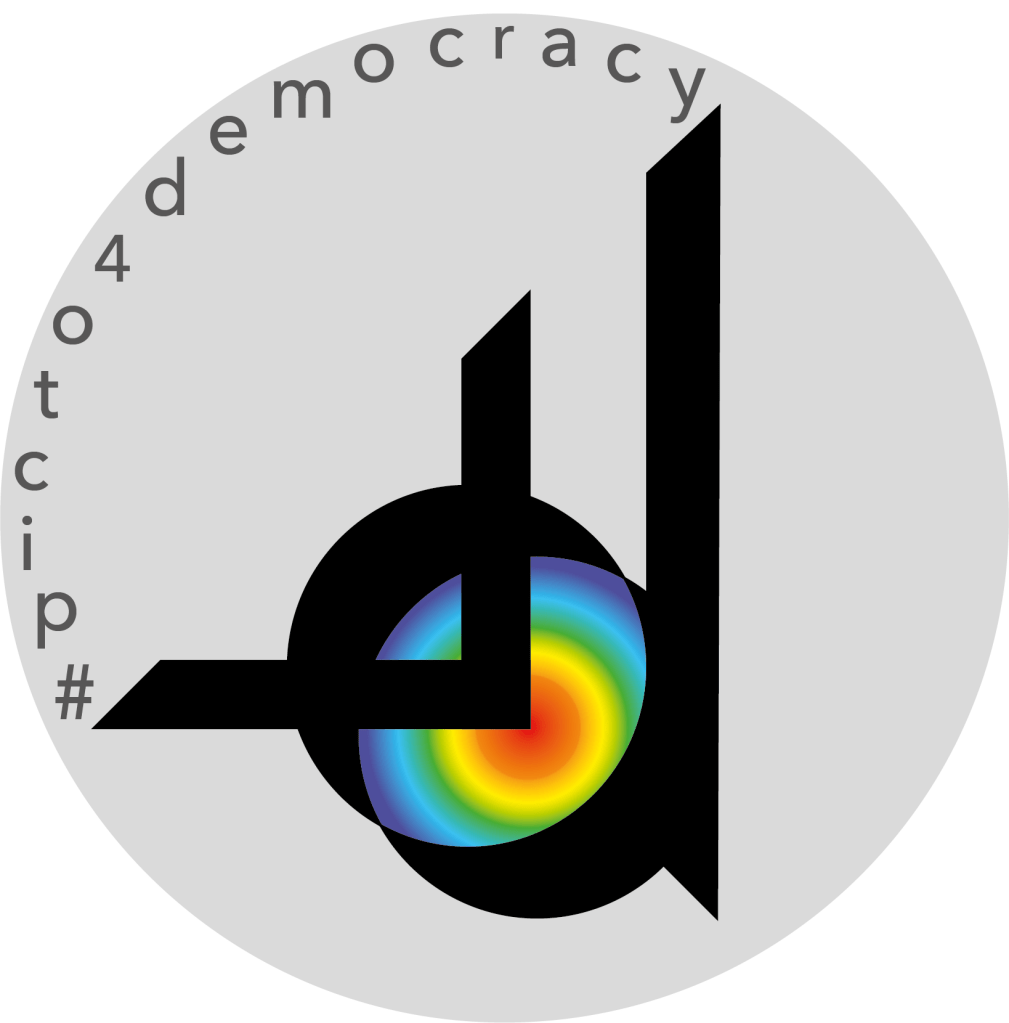
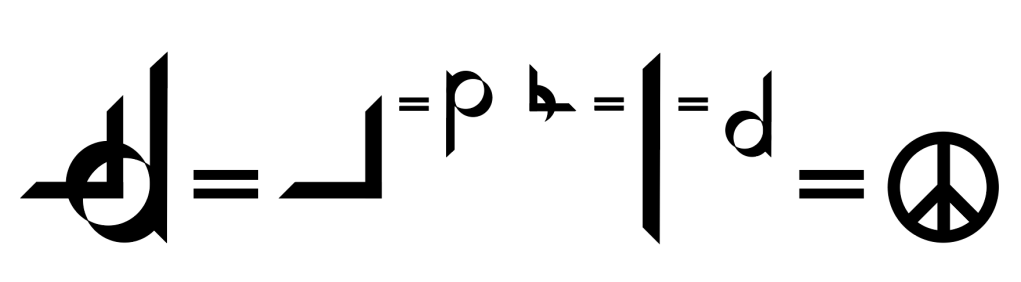
why this picto? The peace sign is internationally known & was designed for a demonstration for nuclear di- sarmament. In the peace sign, the n and the d are represented according to the semaphore alphabet10. The n is a 90° angle opening downwards. The d & also the number 4 are represen- ted by a horizontal line. The peace symbol therefore consists - just like p4d - of a right angle, a line & a circle. In p4d, the 90° angle is rotated clockwise by 90° for the p instead of the n. The pictogram therefore contains a p through the 90° angle as well as a d & a 4 through the line. The fact that the 90° angle intersects the circle also creates a 4. The 90° angle together with the circle symbolizes vote and voice.
references
1V-Dem (2024). Varietes of Democracy. Retrieved from https://v-dem.net
2COW. (2024). Correlates of War (COW) project. Retrieved from http://www.correlatesofwar.org/
3PRIO (2024). Peace Research Institute Oslo - Peacebuilding. Retrieved from https://www.prio.org/
4Doyle, M. W. (1986). Empires, states, and the global system: Actors, audiences, and agendas. Columbia University Press.
5Doyle, M. W. (1983). Kant, liberal legacies, and foreign affairs. Philosophy & Public Affairs, 12(3), 205-235.
6Oneal, J. R., & Russett, B. (2001). Clear and clean: The fixed effects of the liberal peace. International Organization, 55(2), 469-485. https://doi.org/10.1162/00208180151140649
7Levitsky, S., & Ziblatt, D. (2018). How Democracies Die. New York, NY: Crown Publishing.
8Hockley, W. E. (2008). The Picture Superiority Effect in Associative Recognition. Memory & Cognition, 36(7), 1351-1359. https://doi.org/10.3758/MC.36.7.1351
9Meier, C. (1990). The Greek Discovery of Politics. Harvard University Press.
 picto4democracy